
Start Smarter Before You Spend Bigger
Starting an indoor playground, play café, indoor party center, or children’s entertainment center can be a rewarding business — but only when the concept is planned properly before the money is spent.
The mistake many new developers make is jumping straight to equipment, renderings, or lease negotiations before they understand the market, the facility requirements, the operating model, and the guest experience they are trying to build.
SMART Playgrounds helps new owners think through the business of indoor play before committing to major startup costs. From market research and facility layout to playground design, party flow, activity planning, and repeat-visit strategy, the goal is simple:
Build a concept that works as a business, not just a room full of equipment.
For new indoor party center developers, play cafe, children’s entertainment or edutainment centers, the development of your playful concept is really where it all starts:

Most indoor playground ideas begin with a familiar phrase:
“There is nothing for kids to do in our area.”
That may be true, but it is not enough to prove a business opportunity.
A real market review should look at how many families with young children live within your practical driving area, how dense that audience is, how often they may visit, what they currently spend money on, and what other family entertainment options already exist.
You are not just looking for children. You are looking for families who will pay for open play, birthday parties, memberships, food and beverage, events, and repeat visits.
A good market review should help answer:
This is where the project starts to become a business instead of an idea.
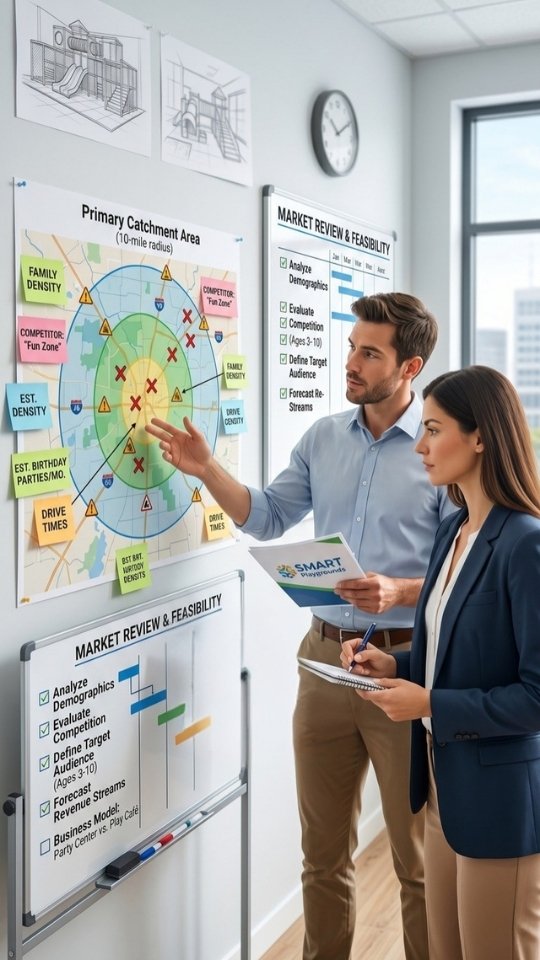
You have been thinking about it for awhile, now it’s time (if you haven’t already) to clearly define your ideal business. Who are you building the business for?
A small play café for toddlers and preschool children has a very different business model than a larger indoor party center designed for children up to 9 or 10 years old. A children’s entertainment center with arcade games, events, food service, and birthday rooms will require different planning again.
Before designing the playground, your layout, service offerings, hours of operations, you need to define the model.
Common indoor playground concepts include:
The right model affects everything: square footage, ceiling height, party room count, staffing, admission pricing, food service, equipment budget, layout, and marketing.

Alright, good stuff – we have a defined business model and potential target customer. The next serious step – is the project business plan.
A realistic business plan can be the biggest hurdle for many excited entrepreneurs. We are idea people, dreamers and doers with no time for sitting around working on a plan, we know will work – if someone would just trust me with a loan we could get it started.
Unfortunately, it doesn’t work that way. In 99.9% of projects, you need financing, investors, landlord approval, and a clear construction budget – business plan is not optional. It is the document that forces the assumptions onto paper.
An indoor playground business plan that can be funded should include:
“The Business plan does not need to be fancy, but it needs to be honest and based in reality…”
A weak plan tells you what you want to hear, and a nice pat on the back for such a great idea, but will seldom find investors. A useful plan tells you what you need to know, attracts project interest and generates the right path forward, before you sign the lease.
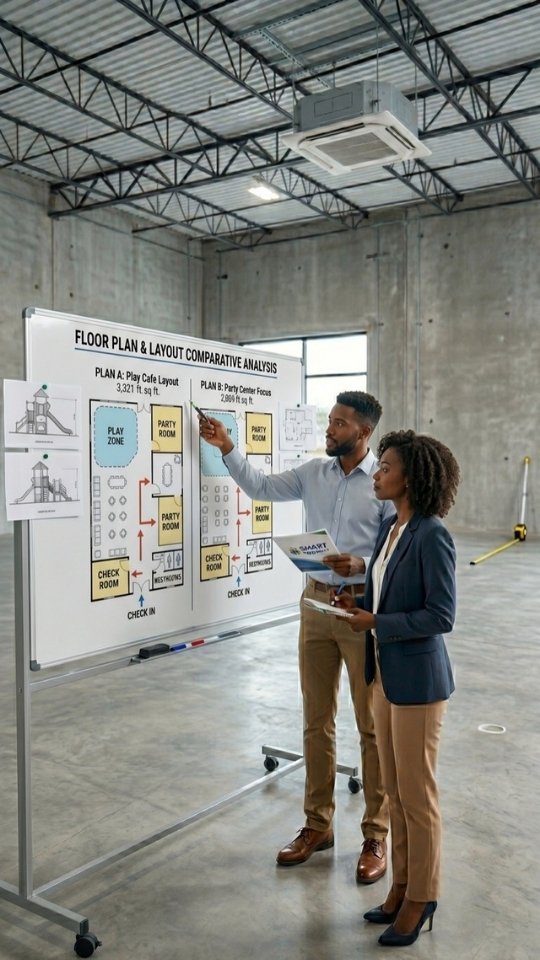
Location matters, both in terms of the geographic location – where your business is located within the community and your catchment area, and the physical location – interior space, ceiling height, parking access, etc. Of the two, both hold equal importance. If you are not located in the best area to draw on your target customers, or the interior space is an odd shape with pillars and low or uneven ceiling, it’s not ideal.
But this is the eternal challenge with location, it is a give and take, best of the worst situation for many projects. Unless you have ability to build from scratch, these challenges need to be met head on.
Indoor playgrounds are often destination businesses, so there is some forgiveness to where the business is located. You do not always need the most expensive retail location beside the busiest big-box store. In many markets, that kind of rent can damage the business before it has a chance to mature.
Indoor playgrounds, play cafés, and party centers often work well in secondary retail, light industrial, mixed-use, or community commercial spaces — provided the building supports the business.
Important location questions include:
The wrong building can add tens or hundreds of thousands of dollars in hidden costs.
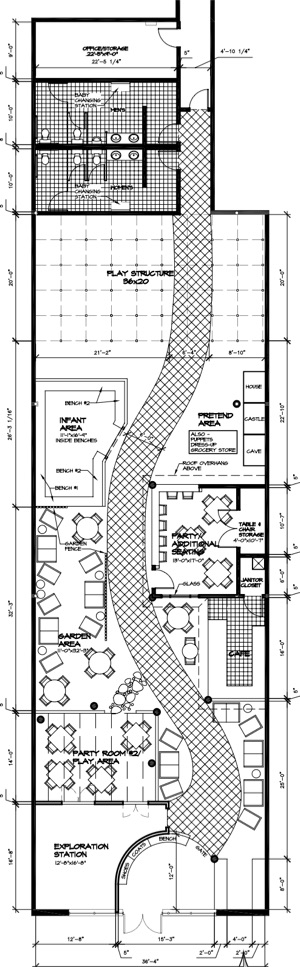
A successful indoor playground layout starts before the play structure is designed.
The building must support how families arrive, check in, move through the facility, watch their children, attend parties, buy food, use washrooms, and exit safely.
The layout should consider:
This is also where cash flow starts to show up in the floor plan. A poor layout can create staffing problems, party bottlenecks, visibility issues, cleaning headaches, and missed revenue opportunities.
The indoor playground is usually the main attraction, but it should not be designed in isolation.
A good commercial playground design should meet the goals of the business plan and match the age group, facility size, ceiling height, budget, capacity goals, parent visibility, and operating model.
The design should consider:
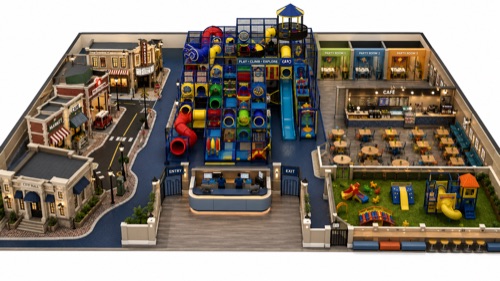
The playground structure creates the physical environment.
The Activity Layer is the planned experience that sits on top of the physical indoor playground structure. While the playground provides the slides, climbs, tunnels, bridges, and movement spaces, the Activity Layer gives children a reason to use those features with purpose.
Indoor playgrounds provide ‘Open Play’, which is a good thing, an energy burner through physical activity. However, open play alone can become difficult to market after the first few years. Families may come when the facility is new, but they return when the experience continues to feel fresh, valuable, and engaging. A strong Activity Layer helps extend the playgrounds appeal and can help operators create repeat visits, stronger birthday programs, weekday events, membership value, and better family engagement without constantly adding more equipment.
A strong indoor playground business (over time) needs more than open play. It needs activities, programs, challenges, events, memberships, parties, and repeat-visit hooks that give families a reason to come back after the first visit.
During the startup process the business plan should unveil local opportunities that go beyond simple weekend open play. By planning ahead, with purposeful design, these opportunities can be fully exploited in a great playground business:
This is where the business becomes more than a play structure. It becomes a repeatable experience.
Check out this indoor play video series on Fun CenterTV. Get an unbiased overview of the steps involved, including location, interior design, layout, attraction mix, party operations and average costs and return.

The cost to start an indoor playground business can vary widely.
A small play café will have a very different startup budget than a larger indoor party center or children’s entertainment center. Costs are affected by building condition, leasehold improvements, playground size, attraction mix, theming, food service, furniture, POS systems, signage, insurance, staffing, marketing, and working capital.
The major cost categories usually include:
The important question is not simply, “How much does an indoor playground cost?” The better question is:
What type of indoor playground business are you trying to build, and does the investment match the market opportunity?
Many startup mistakes happen because the owner is learning too late.
They learn about birthday flow after the party rooms are built.
They learn about staffing after payroll starts.
They learn about playground quality after maintenance problems appear.
They learn about marketing after opening weekend is over.
The SMART Concept Lab is designed to help new developers organize the early planning process before committing to equipment, construction, or a long-term lease.
This is where the idea can be tested against the real-world pieces that matter. If the project makes sense, the next steps becomes clearer.
If it does not make sense yet, it is far better to discover that before on paper, than after signing a lease. The goal is not theory. The goal is better decisions before the expensive decisions are made.
If you are serious about starting an indoor playground, play café, indoor party center, or children’s entertainment center, start with the concept.
SMART Playgrounds can help you review your market, facility idea, layout needs, playground design, activity strategy, and startup path before major money is spent.